
"

The Writing Process

One does not have to be born with great writing talent to write a good paper. Rather, good writing comes from good habits. Poor habits, on the other hand, result in poorly written papers. Some poor habits include 1) writing your paper just before the deadline resulting in a rushed paper or 2) skipping one or more of the steps of writing.

Like any other habit it takes time and practice to become a good writer. This chapter introduces six steps of writing and helps you learn how to be a better writer. This chapter is meant to accompany your writing project, but you can follow these steps whenever you need to write whether at school or in the workplace.
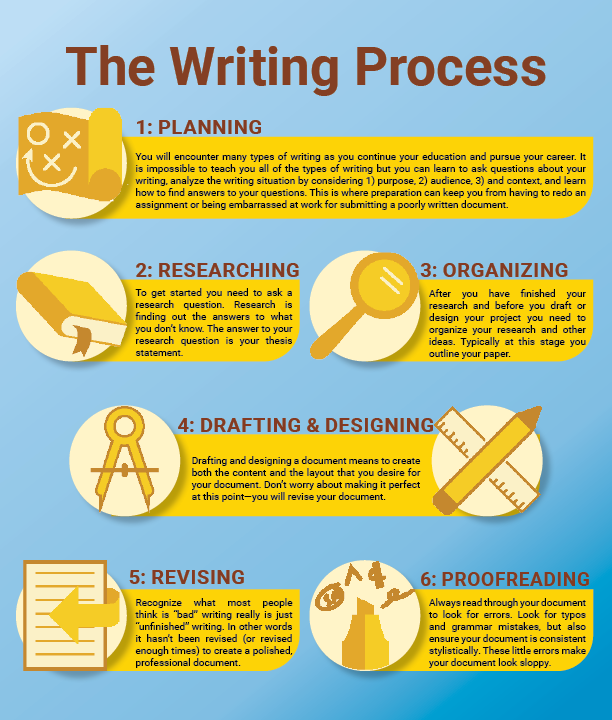

 

Six Steps of Writing
Fig. 1.1. Brian Powell, Salt Lake Community College 2020. (CC BY-NC 4.0 Attribution NonCommercial.)

The Writing Process

  1. Planning

You will encounter many types of writing as you continue your education and pursue your career. It is impossible to teach you all of the types of writing but you can learn to ask questions about your writing and analyze the writing situation by considering 1) purpose, 2) audience, 3) and context and learn how to find answers to your questions. This is where preparation can keep you from having to redo an assignment or being embarrassed at work for submitting a poorly written document.

  1. Researching

To get started you need to ask a research question. Research is finding out the answers to what you don’t know. The answer to your research question is your thesis statement.

  1. Organizing

After you have finished your research and before you draft or design your project you need to organize your research and other ideas. Typically at this stage you outline your paper.

  1. Drafting & Resigning

Drafting and designing a document means to create both the content and the layout that you desire for your document. Don’t worry about making it perfect at this point—you will revise your document.

  1. Revising

Recognize what most people think is “bad” writing really is just “unfinished” writing. In other words, it hasn’t been revised (or revised enough times) to create a polished, professional document.

  1. Proofreading

Always read through your document to look for errors. Look for typos and grammar mistakes, but also ensure your document is consistent stylistically. These little errors make your document look sloppy.

License

Icon for the Creative Commons Attribution-NonCommercial 4.0 International License

Technical Writing @ SLCC Copyright © 2020 by Department of English, Linguistics, and Writing Studies at SLCC is licensed under a Creative Commons Attribution-NonCommercial 4.0 International License, except where otherwise noted.